
pge-corp


PG&E’s service area
- 28,400 employees
*Includes 17,600 employees covered by collective bargaining agreements with three labor unions: International Brotherhood of Electrical Workers (IBEW) Local 1245; Engineers and Scientists of California (ESC) IFPTE 20; and Service Employees International Union (SEIU) Local 24/7.
- 5.6 million electric distribution
- 4.6 million natural gas distribution
*Electric and gas customers are counted separately as customers are given unique service agreement numbers for gas and electric service.
- One of the nation’s largest investor-owned hydroelectric systems
- 7,815 MW of owned hydroelectric, nuclear, natural gas, battery energy storage, and solar generation
- ~108,000 circuit miles of electric distribution lines and 18,000 circuit miles of electric transmission lines
- ~45,200 miles of gas distribution pipelines, 5,650 miles of backbone and local gas transmission pipelines, and various gas storage facilities
- 4.6+ GW of energy storage nameplate capacity under contract
- $10.6 billion in capital investments in 2024 to enhance and upgrade PG&E’s infrastructure for safety, reliability, decarbonization, and wildfire mitigation
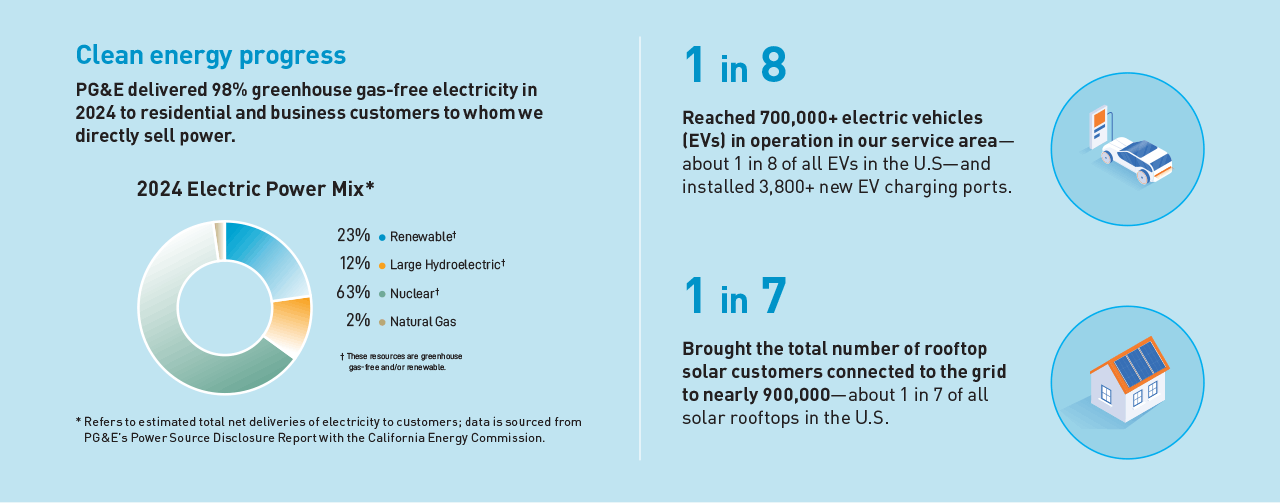
Clean energy progress
Customers at the heart of our strategy
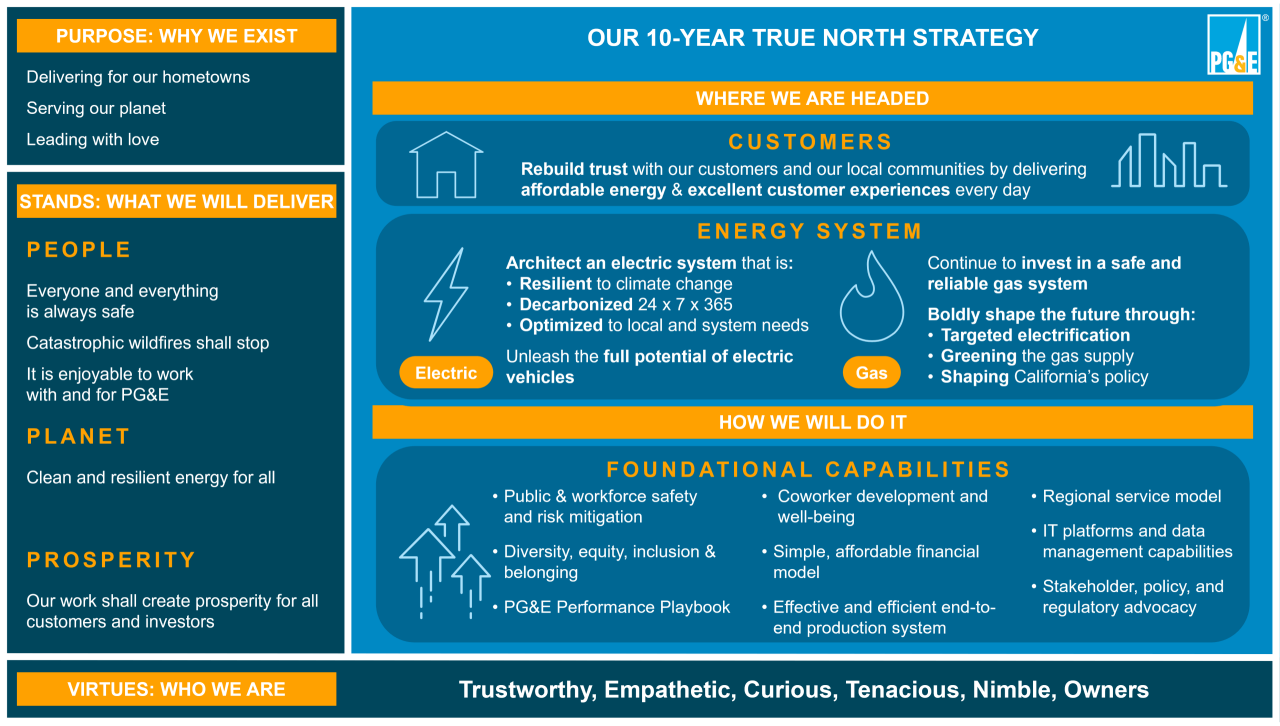
Our purpose—delivering for our hometowns, serving our planet, and leading with love—is rooted in safety as we serve people, the planet, and California’s prosperity.
Our True North Strategy serves as our guidepost, and we are committed to designing an energy system that delivers for our customers and is resilient to climate change, decarbonized, and optimized to local and system needs.

Materiality
PG&E completed its third materiality assessment on corporate sustainability in 2022—a strategic project to help us identify issues that are important for the long-term sustainability of our business and delivering on our commitment to the triple bottom line.
Led by a third-party organization, the materiality assessment1 integrated input from both members of our team and external stakeholders to capture perspectives and expectations, along with significant business and industry research and analysis to incorporate factors related to PG&E’s operating environment.
- This is different from financial materiality, as defined by the U.S. Securities and Exchange Commission. The inclusion of information in our Corporate Sustainability Report is not a characterization regarding financial materiality.
Financial performance
Unless otherwise indicated, the financial information below is derived from PG&E Corporation’s Consolidated Financial Statements as of December 31, 2023, and December 31, 2024, which include the accounts of PG&E Corporation, the Utility, and other wholly owned and controlled subsidiaries.
Financial highlights1
(unaudited, in millions, except share and per share amounts)
- PG&E Corporation’s Consolidated Financial Statements include the accounts of PG&E Corporation, the Utility, and subsidiaries, and have been prepared in accordance with Generally Accepted Accounting Principles (GAAP). All amounts presented in the table above are tax-adjusted at PG&E Corporation’s statutory tax rate of 27.98%, except for certain costs that are not tax deductible. Amounts may not sum due to rounding.
- “Non-GAAP core earnings” and “Non-GAAP core EPS,” also referred to as “non-GAAP core earnings per share,” are non-GAAP financial measures. Non-GAAP core earnings is calculated as income available for common shareholders less non-core items. “Non-core items” include items that management does not consider representative of ongoing earnings and affect comparability of financial results between periods. Non-GAAP core EPS is calculated as non-GAAP core earnings divided by common shares outstanding.
PG&E Corporation and the Utility use non-GAAP core earnings and non-GAAP core EPS to understand and compare operating results across reporting periods for various purposes including internal budgeting and forecasting, short- and long-term operating planning, and employee incentive compensation. PG&E Corporation and the Utility believe that non-GAAP core earnings and non-GAAP core EPS provide additional insight into the underlying trends of the business, allowing for a better comparison against historical results and expectations for future performance.
Non-GAAP core earnings and non-GAAP core EPS are not substitutes or alternatives for GAAP measures such as consolidated income available for common shareholders and may not be comparable to similarly titled measures used by other companies.
- “Non-core Items” include items that management does not consider representative of ongoing earnings and affect comparability of financial results between periods, consisting of the items listed in the table below.
- Excludes 477,743,590 shares of common stock held by Pacific Gas and Electric Company.
Year Ended December 31 (in millions, except per share amounts)
For information about Non-core items in 2023 and 2024, see PG&E Corporation Fourth Quarter and Full Year Earnings report for the years ended December 31, 2023 and December 31, 2024, respectively.
For more information, see PG&E Corporation’s and Pacific Gas and Electric Company’s 2024 Joint Annual Report to Shareholders or Annual Report on Form 10-K for year ended December 31, 2024, which have been filed with the U.S. Securities and Exchange Commission.
Contents
Our Corporate Sustainability Report highlights the strategies and partnerships we’re pursuing to meet our commitment to deliver for our hometowns, serve our planet, and lead with love. Using statistics and stories, the report outlines how we’re working every day to provide safe, reliable, affordable, and clean energy for customers, while also helping to build a more sustainable energy future for California.
The report is organized around the “triple bottom line” framework with sections covering People, the Planet, California’s Prosperity, and our Performance. It features many highlights, including our goal to achieve a net-zero energy system in 2040 as part of our commitment to climate action in California.
The report aligns with the voluntary reporting frameworks of the Global Reporting Initiative, Sustainability Accounting Standards Board, Task Force on Climate-Related Financial Disclosures, and the United Nations Sustainable Development Goals. Throughout this report, when we refer to “PG&E,” we are discussing all of PG&E Corporation and its subsidiaries, including Pacific Gas and Electric Company.
This Corporate Sustainability Report contains forward-looking statements that do not relate strictly to historical or current facts. These forward-looking statements relate to, among other matters, our plans, goals, and strategies with respect to sustainability and environmental matters, improvements in operating procedures and technology, and potential benefits to us therefrom; our efforts to enable our customers to achieve their own ESG goals; demand for our services; competition; government regulation; and other matters. These statements are also identified by words such as “assume,” “expect,” “intend,” “forecast,” “plan,” “project,” “believe,” “estimate,” “predict,” “anticipate,” “may,” “should,” “would,” “could,” “potential” and similar expressions, or by discussions of our guidance, priorities, strategy, goals, vision, mission, opportunities, projections, intentions, or expectations.
These statements are based on current expectations and assumptions, which management believes are reasonable, and on information currently available to management, but are necessarily subject to various risks and uncertainties. In addition to the risk that these assumptions prove to be inaccurate, factors that could cause actual results to differ materially from those contemplated by the forward-looking statements include factors disclosed in PG&E Corporation’s and the Utility’s annual report on Form 10-K for the year ended December 31, 2024, their joint quarterly report on Form 10-Q for the period ended June 30, 2025, and their subsequent reports filed with the Securities and Exchange Commission (SEC), which are available on PG&E Corporation’s website at www.pgecorp.com and on the SEC website at www.sec.gov. Unless otherwise indicated, the statements in this report are made as of July 31, 2025. Some of the factors that could cause future climate and clean energy results to differ materially from those expressed or implied by the forward-looking statements, or from historical results, include, but are not limited to: whether we are able to dedicate adequate resources to implement our climate strategy; uncertainty regarding maturing technologies; uncertainly whether the necessary infrastructure updates will be made to enable a diverse supply of cleaner fuels; the degree to which customers adopt technologies and behaviors that reduce greenhouse gas emissions; regulatory and financing innovations needed to reduce unnecessary new costs for the energy system, and recovering necessary costs in a sustainable, equitable, and affordable manner; the degree to which we attract, retain, and develop a workforce with the required skill profiles to meet our climate strategy; and the impact of changes to federal, state, and local climate policies. Additionally, some of the factors that could cause future customer bills to differ materially from those expressed or implied by the forward-looking statements include risks and uncertainties associated with energy supply costs, emergency response costs, the timing and outcomes of regulatory proceedings, customer energy usage, and procurement costs. PG&E Corporation and Pacific Gas and Electric Company undertake no obligation to publicly update or revise any forward-looking statements, whether due to new information, future events or otherwise, except to the extent required by law.