Highlight
pge-corp

Wildfire safety
Gas safety
Climate resilience
Our approach
PG&E remains steadfast in our stand that catastrophic wildfires shall stop. Our comprehensive Community Wildfire Safety Program builds upon proven layers of protection that ensured no major wildfires were caused by PG&E’s equipment in 2023 and 2024.
The program executes on our comprehensive strategy to reduce ignitions by implementing mitigations designed to minimize the likelihood of catastrophic wildfires, while also maintaining the reliability of the electric system and limiting disruptions to customers arising from our wildfire mitigation efforts.
California’s changed climate is manifested through more frequent and severe wind events, periods of extreme precipitation, and intense hot and dry conditions. This hydroclimate “whiplash” creates rapid transitions between wet periods that promote vegetation growth and dry conditions that turn this vegetation into highly combustible fuel, significantly increasing wildfire exposure. These phenomena amplify wildfire and reliability risks, increasing the urgency for more targeted and scalable mitigations. Our approach reflects both proactive and reactive measures to address this evolving wildfire risk.
Focus areas
Wildfires tend to follow a predictable progression. PG&E’s wildfire mitigation strategy is designed to disrupt the wildfire sequence at various critical stages, effectively breaking the chain reaction that can lead to catastrophic fires. Our wildfire mitigation portfolio focuses on four categories of mitigation to disrupt the wildfire sequence:
- Comprehensive monitoring and data collection
- Operational mitigations
- System resilience
- Community support
Focus areas include:
- Significantly reducing wildfire risk and strengthening the grid against extreme weather events with our cornerstone overhead system hardening and undergrounding initiatives.
- Leveraging transformative technologies to drive our mission forward. We have advanced risk modeling and meteorology, situational awareness, operational mitigations, advanced grid technology, and inspection techniques. We are also in the early stages of building continuous monitoring to obtain more dynamic insight into the state of our electric assets in response to accelerating weather volatility.
- Supporting customers and communities before, during, and after PSPS and Enhanced Powerline Safety Settings (EPSS) events by providing more resources and working year-round to improve our programs.
- Managing vegetation to keep trees and other vegetation a safe distance from powerlines through risk-informed planning and execution of programs.
- Catalyzing targeted community and forest resilience by initiating partnerships and co-developing projects aimed at mitigating the impacts and consequences of wildfires. These efforts include managing fuels within utility rights of way, improving wildfire defenses, and collaborative wood and forest management programs.
The Fire-Threat Map identifies areas across California that have the highest likelihood of a wildfire impacting people and property, and where additional action may be necessary to reduce wildfire risk:
- Tier 3 areas are at extreme risk for wildfire
- Tier 2 areas are at elevated risk for wildfire
2024 milestones
Community wildfire safety program
Our wildfire safety program is evolving each year to reflect lessons learned and demonstrate progress on key initiatives. We also continue to help customers with wildfire safety.
A key lesson learned from the extreme July 2024 heatwave is that we must be ready to quickly adjust our mitigation activities to respond to emerging ignition risk. For example, we executed two additional initiatives to address elevated risk exposure: supplemental distribution pole clearing and deployment of pole mounted continuous monitoring devices.
Monitoring risk exposure is critically important. PG&E remains committed to continuously assessing evolving threats and maintaining a proactive, adaptive approach to wildfire mitigation:
- PG&E continues to evolve our vegetation management practices, using risk-informed planning to develop and execute on a portfolio of programs. Building upon lessons learned, PG&E is streamlining our inspection programs while targeting high risk areas of the system to continuously reduce ignitions associated with vegetation.
- PG&E uses a suite of comprehensive situational awareness programs, such as a full-time Hazard Awareness Warning Center (HAWC), satellite detection, and AI-enabled wildfire cameras to quickly detect and respond to imminent wildfires.
- PG&E is collaborating with local communities, fire departments, and other stakeholders to create a more comprehensive approach to wildfire prevention. Our public safety specialists interact with local communities, local fire departments, and emergency services organizations on an ongoing basis to provide wildfire and PSPS emergency preparedness information and response support. We also support county-level rapid response measures such as providing fire agencies access to PG&E’s helicopter fleet to be used for aerial fire suppression.
Undergrounding and system upgrades
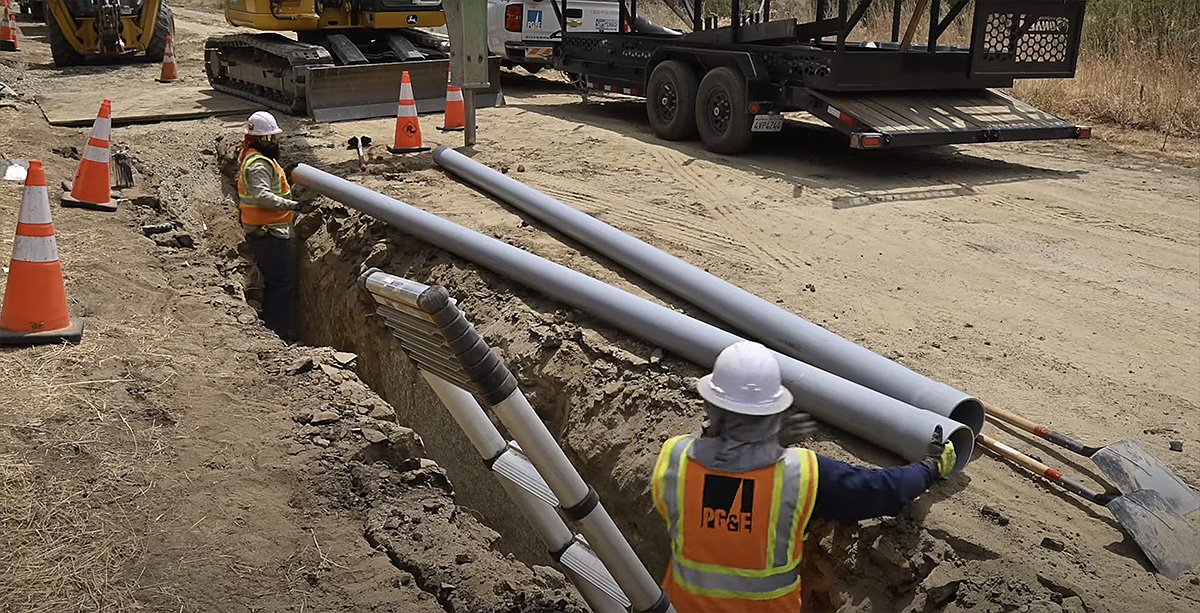
PG&E is reducing the risk of wildfires by moving powerlines underground and completing wildfire safety system upgrades above ground. Our system upgrade efforts include installing strengthened power poles and covered powerlines, and in some cases, removing powerlines if the lines are no longer needed.
Together, this work helps to reduce wildfire risk and improve system reliability in some cases. Undergrounding permanently eliminates nearly 98% of wildfire risk from the area where this work occurs, while also reducing ongoing maintenance and expenses by decreasing the need for future tree work.
EPSS program
These advanced safety settings enable us to automatically shut down power within a fraction of a second if a fault, such as a contact with a broken branch, is detected on a line, preventing potential sparks that could cause an ignition. All distribution lines in high-fire risk areas and select adjacent buffer areas are EPSS-protected.
PSPS program
PG&E uses targeted, data-driven PSPS events during extreme weather conditions to proactively de-energize power lines when there is a high wildfire risk, minimizing the impact on our customers while keeping safety a priority. Through advanced alert systems, customers, partners, and agencies receive real-time updates on wildfire risk and outages, along with other resources to prepare for emergencies.
In 2024, six targeted PSPS events were needed—the largest affecting about 21,000 customers in 17 counties and four Tribal communities, and the smallest affecting 212 customers in three counties and no Tribal communities. Two PSPS events in 2023 affected about 5,100 customers.
Measuring progress
Wildfire mitigation
Our wildfire protection work is making our system safer and more resilient while positioning us to better serve customers and respond to our state’s evolving climate challenges.
In 2024, PG&E completed the following:
- Undergrounded 258 miles of lines.
- Completed 132 miles of distribution system hardening, including installing stronger poles and overhead powerlines, as well as line removal where powerlines were no longer needed.
- Installed 144 sectionalizing devices.
- Provided 4,347 portable batteries and 1,447 permanent batteries to vulnerable customers at risk of PSPS or EPSS outages.
These charts show cumulative progress between 2022 and 2024.
Cumulative wildfire mitigation progress
- Sectionalizing device results may vary based on scope fluctuations.
- Data only included portable batteries.
Electric system reliability
In 2024, the average time a PG&E customer was without power (known as SAIDI) was 276.7 minutes, and the average number of power interruptions per customer (known as SAIFI) was 1.824, or just more than one outage per customer per year. Both results declined due to a variety of factors, including severe winter storms, heat-related outages later in the year, and our strategy to disable reclosers and to utilize PSPS in high-fire threat areas to help prevent wildfires.
Electric reliability progress
- System Average Interruption Duration Index (SAIDI) is the amount of time the average customer experiences a sustained outage (being without power for more than five minutes) each year.
- System Average Interruption Frequency Index (SAIFI) is the number of times the average customer experiences a sustained outage each year.
PG&E also works to reduce the number of customers who experience multiple sustained outages, measured as a percentage of the total customers served, through our outage review team process, which works to quickly identify and address local reliability challenges. With a result of 0.500, we fell short of our 1.000 target due to the same drivers impacting SAIDI and SAIFI performance.
We also achieved a 98.3% electric emergency response rate, exceeding our target of 97.6%. This measures the percentage of time PG&E personnel were on site within 60 minutes after receiving a 911 call of a potential PG&E electric hazard.
Electric system progress
- Measure reflects the total number of customers experiencing 5 or more (CEMI-5) or 10 or more (CEMI-10) sustained interruptions. Metrics are reported as a year-to-date measure for a rolling 12-month period and are calculated as a composite index with CEMI-5 weighted at 60% and CEMI-10 weighted at 40% and both calculated as a customer count. This revised weighting (compared to 50/50 in 2022) reflects a continued focus on customer experience and our accountability to provide reliable electricity.
Highlight
In 2024, Lloyd’s Register Quality Assurance conducted a thorough recertification audit of PG&E’s Electric Asset Management System, resulting in our continued International Organization for Standardization (ISO) 55001 certification.