Sustainability Highlight
pge-corp

Wildfire safety
Gas safety
Climate resilience
Our approach
Our comprehensive Community Wildfire Safety Program (CWSP) includes short-, medium- and long-term plans to reduce wildfire risk and keep our customers and communities safe. Focus areas include:
- Undergrounding 10,000 miles of distribution powerlines in the coming years.
- Supporting customers and communities before, during, and after Public Safety Power Shutoff (PSPS) and Enhanced Powerline Safety Settings (EPSS) events by providing more resources and working year-round to improve our programs.
- Vegetation management to keep trees and other vegetation a safe distance from powerlines.
- Continuing to build a safer and more resilient system by hardening lines and installing sectionalizing devices that help to reduce the size of outage events.
- Testing and using new tools and technologies to pinpoint how to best prevent and respond to the risk of wildfires.
The High Fire-Threat District Map identifies areas across California that have the highest likelihood of a wildfire impacting people and property, and where additional action may be necessary to reduce wildfire risk:
- Tier 3 areas are at extreme risk for wildfire
- Tier 2 areas are at elevated risk for wildfire
2023 milestones
Community wildfire safety program
Our wildfire safety program is evolving each year to reflect lessons learned and demonstrate progress on key initiatives. We also continue to help customers with wildfire safety.
PG&E is installing sectionalizing devices and transmission switches able to limit the size of outages so fewer communities are without power during times of highest wildfire threat. We are also hardening distribution circuit miles with stronger poles and covered powerlines to increase system resiliency and installing temporary microgrids to keep the electricity on during PSPS and EPSS events.
We are managing vegetation near powerlines and inspecting all lines and structures in Tier 3 areas and one-third of lines and structures in Tier 2 areas on the CPUC Fire-Threat Map to help reduce wildfire risks caused by equipment issues.
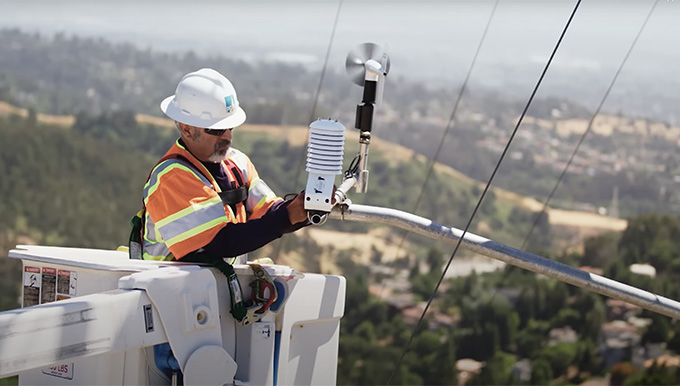
We are also utilizing weather stations and high-definition cameras to improve extreme weather forecasting and using our Hazard Awareness and Warning Center (HAWC) to coordinate wildfire prevention and response actions and be ready for a variety of potential natural disasters and emergencies.
Undergrounding 10,000 miles of powerlines
PG&E’s initiative to underground 10,000 miles of powerlines in high fire risk areas represents the largest effort in the United States to underground powerlines to reduce wildfire risk, as well as harden the grid against other types of extreme weather.
The benefits of undergrounding are:
- Safety by reducing the risk of wildfires
- Dependability by reducing the need for PSPS and EPSS outages and improving service reliability
- Resilience to extreme weather events caused by a changing climate
- Sustainability by saving trees and beautifying our hometowns
EPSS program
For the safety of our customers and communities, PG&E has enhanced safety settings on our powerlines designed to automatically turn off power within one-tenth of a second if a wildfire threat is detected. All distribution lines in high-fire risk areas and select adjacent buffer areas are EPSS-protected.
PSPS program
As we work to build the electric system of the future with efforts like undergrounding and system hardening, our use of PSPS as a measure of last resort is expected to decline.
In 2023, two targeted PSPS events were needed—one that affected 3,928 customers in seven counties and two tribal communities and one that affected 1,171 customers in three counties. We did not initiate any PSPS events in 2022. That compares to five PSPS events affecting about 80,000 customers in 2021, six events affecting about 650,000 customers in 2020, and seven events affecting about two million customers in 2019.
Measuring progress
Wildfire mitigation
Our wildfire protection work is making our system safer and more resilient while positioning us to better serve customers and respond to our state’s evolving climate challenges.
In 2023, 364 miles of lines were undergrounded in 2023—double the 180 miles completed in 2022. Since PG&E launched its undergrounding program in mid-2021 through the end of 2023, over 600 miles of distribution circuits have been put underground.
Additionally, we installed 76 sectionalizing devices and transmission switches and hardened 447 distribution circuit miles to increase system resiliency—achieving cumulative totals of 1,427 devices and switches and 1,671 distribution circuit miles, respectively. We also completed our programs to install and operationalize weather stations and high-definition cameras.
This table shows the cumulative progress between 2021 and 2023.
Electric system reliability
In 2023, the average time a PG&E customer was without power (SAIDI) was 255.9 minutes, and the average number of power interruptions per customer (SAIFI) was 1.558, or just more than one outage per customer per year. Both results were an improvement from the prior year.
- System Average Interruption Duration Index (SAIDI) is the amount of time the average customer experiences a sustained outage (being without power for more than five minutes) each year.
- System Average Interruption Frequency Index (SAIFI) is the number of times the average customer experiences a sustained outage each year.
PG&E also works to reduce the number of customers who experience multiple sustained outages, measured as a percentage of the total customers served, through our outage review team process, which works to quickly identify and address local reliability challenges. With a result of 0.98, we narrowly fell short of our 1.0 target.
We also achieved a 97.2% electric emergency response rate—the percentage of time that PG&E personnel were on site within 60 minutes after receiving a 911 call of a potential PG&E electric hazard.
- Measure reflects the total number of customers experiencing 5 or more (CEMI-5), or 10 or more (CEMI-10) sustained interruptions. Metrics are reported as a year-to-date measure for a rolling 12-month period and are calculated as a composite index with CEMI-5 weighted at 60% and CEMI-10 weighted at 40% and both calculated as a customer count. This revised weighting (50/50 in 2022) reflects a continued focus on customer experience and our accountability to provide reliable electricity.
Sustainability Highlight
In 2021, we achieved International Organization for Standardization (ISO) 55001 certification for our asset management systems in our Electric Operations and Electric Engineering organizations, a sign of progress in our safety culture. Lloyd’s Register awarded the certification after a rigorous evaluation process that was more than three years in the making and included a comprehensive review of our electric operations. In 2023, we continued to adopt best practices and began the re-certification journey.