
Sustainability Highlight
pge-corp

At PG&E, our work to keep the public safe ranges from comprehensive programs to train our workforce to investments in our gas and electric infrastructure to expanding our efforts to reduce wildfire risks. We continue to prioritize safety, and the necessary steps and actions that must be taken to make the energy system safer.
Our approach
Embedding safety in our operations
Our Workforce Safety Strategy encompasses many ways to make our operations safe, including training, daily safety tailboards, updates to safety protocols and programs, safety observers in the field, and a robust SIF program that evaluates the root causes of accidents and near misses and provides corrective actions to prevent them from happening again.
We take a multifaceted approach to protect the safety of the public through our operations:
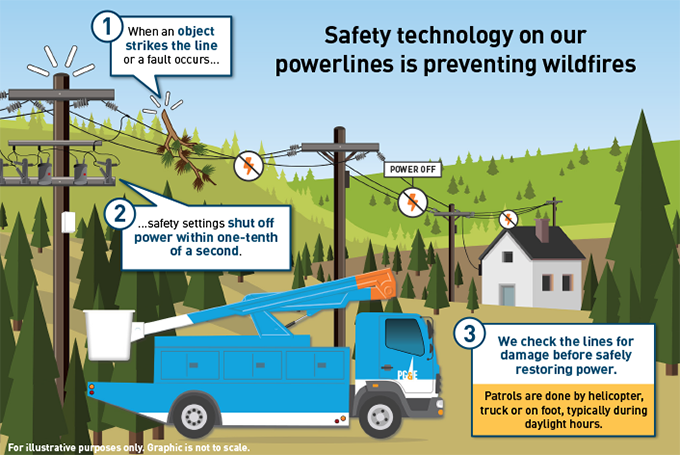
- Electric Operations: Includes efforts to harden our infrastructure, modernize the grid, and execute our Community Wildfire Safety Program to continue to mitigate the risk of our equipment igniting fires.
- Gas Operations: Includes achieving and maintaining best-in-class asset management certifications, meeting compliance standards, and maintaining rigorous pipeline safety management systems.
- Power Generation: Includes safely operating the Diablo Canyon Power Plant and our natural gas-fired generation facilities and continuing to inspect and maintain our hydroelectric system according to strict safety guidelines.
Community wildfire safety program
The fire season in California is starting earlier and ending later than the historic norm due to climate change, and fires are becoming larger and spreading faster. Our wildfire safety program is evolving each year to reflect lessons learned and incorporate new information.
In 2023, we achieved and exceeded the goals of our Wildfire Mitigation Plan (WMP), including undergrounding 364 miles of powerlines and hardening 447 distribution circuit miles to increase system resiliency.
We reached more than 3.8 million Californians through the Safety Action Center, a dedicated safety webpage featuring information about wildfire risks and what customers can do to keep their home, family, or business safe during an emergency. The site includes the “7 Saturdays to a More Fire-Resistant Home” video series, which has garnered nearly 1.5 million views since its launch in 2021.
Gas safety
Our 2024 Gas Safety Plan demonstrates PG&E’s commitment and progress in implementing processes, programs, and procedures to keep our hometowns safe. Our plan outlines the work we accomplished in 2023 including:
- How we’ve embraced the Lean operating system and are transitioning to the PSEMS, an integrated safety management system based on industry standards.
- How we’ve deployed gas operations “model yards” — sites where our teams demonstrate best practices, including Lean operating system training for frontline workers.
- How we’ve completed “breakthrough” training to empower leaders and their teams to shift their mindset to achieve extraordinary outcomes.
Emergency preparedness and response
To prepare for major weather events and natural disasters—earthquakes, wildfires, floods, heavy winds, and blizzards—PG&E relies upon our enterprise-wide Emergency Preparedness and Response (EP&R) organization. We continually review and strengthen our catastrophic emergency response plans to maintain:
- Clearly defined organizational structures, roles, and responsibilities.
- Restoration priorities that incorporate community needs to help customers get back to normal.
- Effective logistics plans that support restoration needs.
- Technology that is ready and available to support our response.
- Coworkers who are trained and fully understand their emergency roles.
- Coworkers who are personally prepared for emergencies and ready to respond at home and at work.
In 2023, under the direction of EP&R, PG&E activated our Emergency Operations Center 12 times to coordinate our activities during multiple events, including atmospheric-river winter storms, PSPS events, and company exercises on responding to wildfires and cybersecurity events.
In an emergency situation, we coordinate and communicate with police, fire, and other officials in an effort to keep the public and first responders safe. PG&E maintains a secure First Responder website, where emergency officials can access training materials and infrastructure information and maps.
Cyber and physical security
PG&E operates infrastructure that has been deemed critical to our national and economic security. As such, we are firmly committed to working with other gas and electric providers, other essential industries, and government officials to develop and implement state-of-the-art security strategies and best practices.
PG&E’s Enterprise Protection organization demonstrates our commitment to addressing evolving threats and complex cyber and physical security risks. We seek to continually improve our services through strategic deployment of our resources, standardizing security practices and policies, and reinforcing and promoting security awareness across the enterprise.
Our Enterprise Protection organization leads our efforts to detect, monitor, and respond to cybersecurity threats and attacks. To test and refine our ability to respond to threat scenarios, we hold an enterprise-wide training exercise each fall and participate in the national GridEx grid security cyber exercise every other year.
As PG&E’s technological footprint expands, the need to protect our people, assets, and information from attacks becomes even more essential. We have made investments to modernize our security infrastructure and build service capability, providing the security team with tools they need to manage challenges to our critical infrastructure. As part of this commitment, PG&E participates in the Cybersecurity Risk Information Sharing Program, which is a threat monitoring and intelligence sharing program sponsored by the U.S. Department of Energy.
Once risks are identified and prioritized, we develop mitigation plans to protect the enterprise and reduce risk. The approach includes continually evolving our capabilities to address tactics used by threat actors amid a changing technology landscape. PG&E has around-the-clock centralized security monitoring operations for threat detection, situational awareness, incident management, and emergency response to proactively defend PG&E from both cyber and physical threats.
2023 milestones
Emergency preparedness and response
- Maintained our Hazard Awareness and Warning Center year-round with its capabilities to monitor for a wide range of natural disasters and emergencies.
- Used our Vacaville Emergency Response Center regularly, a 30,000-square-foot facility with redundant power and telecom, for emergency activations and exercises.
- Hosted more than 230 training workshops to better prepare firefighters, police, public works officials, and other authorities to respond to emergencies involving electricity and natural gas. We also met with more than 350 local fire entities to address contingency planning for gas-related events.
- PG&E and The PG&E Corporation Foundation provided $1.4 million to the California Fire Foundation’s Wildfire Safety and Preparedness Program.
Public safety awareness
- Encouraged customers and contractors to call 811 before digging, the best safeguard and the first line of defense to preventing strikes on underground utility lines. Special focus came during Safe Digging Month (April) and on Call 811 day (August 11).
- Emphasized safety around downed powerlines by providing safety tips online and through a public advertising campaign and social-media posts.
- Maintained a standalone cloud-based website specifically for emergencies, including PSPS content and tools for easier usability for customers.
- Promoted public safety around PG&E waterways, including dam safety and encouraging customers to take extra precautions around hydroelectric facilities and dams, where water flows can change rapidly.
- Took a stand against scams as part of the Utilities United Against Scams, a consortium of more than 100 American and Canadian energy companies.
Measuring progress
PG&E tracks our public safety performance via a set of public safety metrics with the aim of continuous improvement.
In 2023, customer welfare—prioritizing public and workforce safety—represented 75% of management’s annual at-risk performance-based pay. Financial stability was weighted at 25%. This breakdown was continued in 2024.