Engaging stakeholders
pge-corp

At PG&E, we value the rich diversity of the customers and communities we serve, and we strive to continuously deliver for our hometowns.
Our approach
Led by Pacific Gas and Electric Company’s Executive Vice President and Chief Customer Officer, we are working to deliver the best experience for each and every customer. This includes using data-informed insights to improve the customer experience, localizing our presence and strategies in the communities we serve, and empowering customers with greater choice and control over how they manage their energy use. We also continuously integrate customer feedback to develop, enhance, and improve our products and services.
Serving customers locally
Our Regional Service Model improves the relationship and trust between PG&E and our customers by increasing local accountability and bringing our operational leadership closer to our customers. Our regional teams live and work in their communities and lead cross-functional efforts within each PG&E region to address local issues and incorporate the needs and concerns of our customers into operating decisions.
Integrating feedback
PG&E regularly uses customer surveys, focus groups, online customer panels, and other forms of research to obtain feedback and insights that help drive our decision-making and improve how we serve our customers. We also host customer collaboration sessions to hear from and collaborate with customers on improving service solutions.
We engage with a number of stakeholder groups on a regular basis, including:
- Sustainability Advisory Council, which provides independent expertise to help ensure that PG&E’s business strategy, operations, and future energy network incorporate sustainability best practices.
- California Community Advisory Group, which serves as a forum for the exchange of ideas between PG&E and a diverse mix of community-based and civic organizations.
- Undergrounding Advisory Group, which provides a forum for PG&E to share information and receive input and ideas on our 10,000-mile Undergrounding program.
- Customer Advisory Group, which provides a forum to strengthen our strategic engagement with large customers to better serve them and meet their needs.
- Local Stakeholder Advisory Groups, which discuss significant projects and topics relevant to the local area.
- People with Disabilities and Aging Advisory Council, an externally focused advisory council comprised of a diverse group of recognized leaders from community-based organizations (CBOs) who support our most vulnerable customer populations.
- Communities of Color Advisory Group, which provides guidance on outreach strategies to effectively communicate rate options and energy affordability programs to diverse and hard-to-reach communities.
- Clean Transportation Program Advisory Council, which provides feedback and guidance on PG&E’s electric vehicle programs.
- Diablo Canyon Decommissioning Engagement Panel, which provides diverse community viewpoints to help inform PG&E’s site-specific decommissioning plan on future land use and repurposing recommendations.
Customer engagement on wildfire programs
We continue to engage with customers and educate them on our Community Wildfire Safety Program as we respond to California’s continued wildfire risk. The program includes critical layers of protection to help prevent wildfires, improve reliability, and reduce costs over the long term.
We know that losing power disrupts lives, especially for customers who rely on power for medical devices or medications. To reduce the impacts of our wildfire-safety programs, we are listening to our customers and responding to feedback by providing more information and better resources.
PG&E maintains the Safety Action Center, a dedicated online safety resource featuring helpful information about wildfire risks and what customers can do to keep their homes, families, and businesses safe, including tips on how to create an emergency plan, emergency preparedness guides and videos, and links to the statewide Power of Being Prepared campaign and other resources.
In 2023, PG&E had two PSPS de-energization events, and continued enablement of EPSS in high fire threat areas during times of high fire risk. We continue to work on enhancements to our programs, including mitigation support and customer communications, such as:
- Reached more customers potentially impacted by wildfire safety outages:
- Delivered 4,700+ portable batteries
- Provided 2,900+ rebates for generators and batteries
- Installed 4,600+ backup power transfer meters
- Conducted pre- and in-season outreach to help Medical Baseline customers prepare to stay safe before a PSPS event.
- Deployed Community Resource Centers to help customers during PSPS events by providing a safe place to access electricity, get updates, and find resources.
- Provided emergency information in 16 languages, partnered with CBOs to conduct multilingual outreach, and developed additional American Sign Language notifications.
- Supported meal replacement options from local food banks to cover every county likely to be impacted by PSPS events.
- Improved customer notifications when outages occurred on EPSS-enabled lines and conducted additional outreach to those impacted by outages on EPSS-enabled circuits.
PG&E also reserved approximately 40 megawatts of temporary generation in 2023 to be deployed to mitigate the impacts of wildfire safety outages.
Sustainability Highlight
PG&E actively works to strengthen our engagement with tribal governments to better serve their communities. We’re also building internal capacity within PG&E through training for coworkers on tribal cultural awareness, tribal governmental structure, and tribal expectations of PG&E.
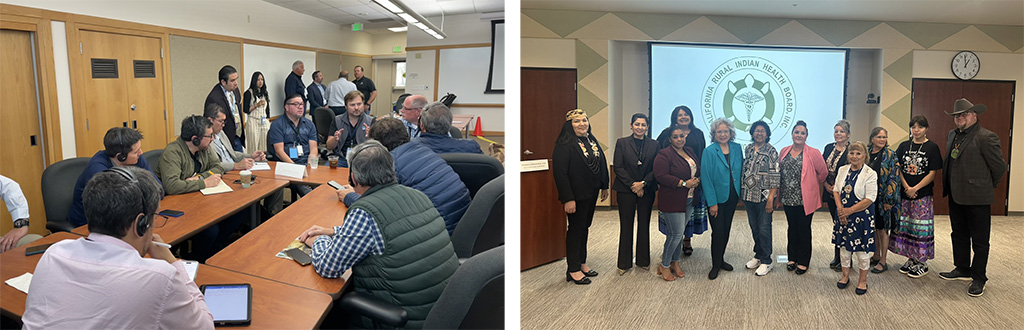
Photos show (left) PG&E leaders consulting with representatives from Peru on engaging with Tribes on wildfire safety and preparedness and (right) discussing wildfire safety, resilience, and vegetation management with Tribal leaders at the California Rural Indian Health Board.
Highlights from 2023 included:
- Worked to understand the impacts of wildfire safety outages and other service disruptions through:
- Listening sessions with tribal governments
- Regional working groups with tribal, local, county governments, CBOs, and Public Safety Partners
- Tribal-specific Regional Working Group with our Regional Vice Presidents
- Wildfire safety working sessions with tribes and counties
- Support during several all-hazard events and emergencies
- Convened PG&E senior leaders with tribal governments, including between our CEO and tribal leadership on a tribal reservation.
- Distributed a quarterly tribal newsletter covering our income-based programs.
- Offered a Tribal Mini Grant to help with enrollment in our financial assistance programs, prioritizing the Access and Functional Needs (AFN) community.
- Engaged with the California Rural Indian Health Board in their request for Congressional support to obtain funding for backup generation for all tribal health facilities in California.
- Coordinated with tribes to deploy PG&E’s self-generation and community microgrid programs on tribal lands.
- Coordinated with the Department of Energy to assist in tribal consultation on 40101(d) grants.
- Cohosted the Tribal Clean Energy Summit with California’s investor-owned utilities and the DOE, CEC, and CPUC.
- Worked with tribal food distribution programs to provide support for food security on tribal lands and engaged with tribal housing programs to provide financial support for all-hazard events.
Beyond these efforts, we are working with tribal governments to develop memoranda of understanding that cover expectations for our work together. We also continue to implement the CPUC’s land transfer policy to assist with the efforts to make the process work for tribal governments.
Making it easy
Pacific Gas and Electric Company’s website (www.pge.com) offers customers an easy and convenient way to manage their account online. Customers can view and download their hourly usage and cost data, in addition to comparing their usage to that of similar homes in their neighborhood. The website also features an updated outage map and information on support before, during, and after outages.
Our Home Energy Checkup and Business Energy Checkup tools allow residential and small and medium business customers to find energy savings ideas by providing tips and savings recommendations to help them manage their energy costs.
Our energy statements provide clear and easy-to-understand information, and a growing number of customers have chosen to enroll in our paperless billing option. We offer customers a variety of payment options.
Customers can start, transfer, or stop service via our website; they can also schedule appointments to relight their gas pilot lights online. The website allows customers to sign up for numerous service-related alerts, including outage, billing and payment, and appointment notifications. Energy Alerts will notify customers when their energy usage is on the rise and allow them to use My Rate Analysis to make sure they are on the right rate plan.
In addition to digital offerings, PG&E continues to offer self-service capabilities over the phone, such as reconnection service. Many of our communications are also available in multiple languages and formats, including English, Spanish, Chinese, Vietnamese, Tagalog, Braille, and large print.
Measuring progress
We are committed to improving satisfaction for both residential and business customers. We closely monitor our Customer Satisfaction Score and act based upon customer feedback. In recent years, customer satisfaction with PG&E has declined due to factors such as higher bills and outages tied to extreme weather conditions. However, we are putting countermeasures in place to mitigate the impact of these challenges and to improve the customer experience moving forward.
Measuring customer satisfaction1
- To measure customer satisfaction, we use a random-sample, proprietary customer survey that is conducted by an independent third party. The customer satisfaction score is determined by averaging customers’ overall satisfaction with our products and services using a 1 to 10 scale, indexed to a score from 1 to 100.