
Reducing our Carbon Footprint
Our Climate Goals At PG&E, we are committed to doing our part to transition California to a decarbonized and climate-resilient economy. This commitment includes aligning our resources and business strategy with the state’s clean energy vision and working to reduce the carbon footprint of our operations and the energy we produce.
We also aim to support environmental and social justice through partnerships as we work to enable our customers and communities to reduce their carbon footprint.
On this page:
(Skip to main navigation)Our Approach
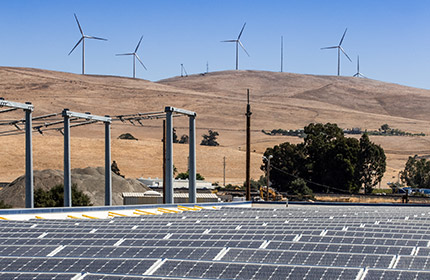
We are also working to support the state’s implementation of SB 100 and carbon neutrality by 2045 in a reliable and cost-effective manner for customers. SB 100 includes increased Renewables Portfolio Standard (RPS) objectives and clean energy goals, and Executive Order B-55-18 sets a statewide goal to achieve carbon neutrality no later than 2045.
We are participating actively in legislative efforts to codify the carbon neutrality goal and in proceedings at the CPUC, CEC, and CARB to determine how to achieve carbon neutrality.
Addressing Our Own Carbon Footprint
Our Million Ton Challenge is a voluntary five-year carbon reduction goal to avoid one million tons of cumulative greenhouse gas emissions from our operations from 2018 through 2022, compared to a 2016 baseline.
To meet the goal, we are working to reduce emissions across several business areas:
- Saving energy through energy-efficient and more sustainable facilities,
- Reducing methane emissions from natural gas operations,
- Continuing to deploy a smarter, cleaner fleet of PG&E vehicles, and
- Adopting environmentally responsible products and services, with a focus on electric substation equipment.
Engaging Our Customers and Communities
PG&E actively works with customers to help them achieve energy savings and greenhouse gas emission reductions through a broad range of programs and incentives for energy efficiency, demand response and distributed generation and storage. These efforts include helping local governments develop strategies and implementation plans to save energy and reduce emissions, and connecting them with PG&E programs and other resources to help them meet their energy goals.
Air Quality and Environmental and Social Justice
PG&E is working to strengthen our engagement and collaboration with environmental and social justice stakeholders, as part of our enterprise-wide effort to better address the needs of these communities. This work is guided by PG&E’s Environmental Justice Policy (PDF).
In 2017, California took an important step to address air pollution in the most environmentally burdened communities through the passage of AB 617, which directs CARB to develop a community air monitoring and community emissions reduction program and to deploy them in the highest priority communities.
PG&E strongly supports a comprehensive, statewide air protection program and was actively engaged in the development and passage of AB 617. PG&E is working with CARB and other stakeholders through the AB 617 implementation process to ensure that the community air-protection programs are successful and effective at reducing emissions in disadvantaged communities.
2021 Milestones
- Delivered clean energy to customers with more than 90% of the electricity from greenhouse-gas-emissions free sources.
- Reduced emissions from our operations through the fourth year of the Million Ton Challenge, avoiding more than 500,000 tons of CO2. We’ve already exceeded one million tons and are pursuing additional reductions in the final year by reducing methane emissions from natural gas operations, deploying clean fleet vehicles, promoting energy-efficient and more sustainable facilities, and reducing SF6 emissions from substation equipment.
Measuring Progress
We believe it’s essential that investors, customers, policymakers, and other stakeholders have access to information that allows them to assess and understand the risks and opportunities associated with climate change.
Mandatory Emissions Reporting
Under AB 32’s annual reporting requirements, PG&E reports greenhouse gas emissions to CARB. These reports include emissions from our electric generation facilities, natural gas compressor stations, natural gas supplied to customers, and the fugitive emissions from our natural gas distribution system and compressor stations. The following table shows the greenhouse gas emissions data PG&E reported to CARB under AB 32.
| 2019 | 2020 | 2021 | |
|---|---|---|---|
| Total CO2-e Emissions (metric tons) | 2,484,127 | 2,550,622 | 2,485,379 |
| Humboldt Bay Generating Station | 189,163 | 227,214 | 256,813 |
| Gateway Generating Station | 1,137,160 | 1,143,587 | 1,363,629 |
| Colusa Generating Station | 1,157,804 | 1,179,821 | 864,937 |
| CO2 Emissions Rates (lbs/MWh) | |||
| Humboldt Bay Generating Station | 1,028 | 1,033 | 1,035 |
| Gateway Generating Station | 872 | 882 | 875 |
| Colusa Generating Station | 842 | 855 | 866 |
| Fossil Plants Footnote 2 | 868 | 881 | 886 |
| All Plants Footnote 3 | 163 | 194 | 204 |
| Other CO2-e Emissions (metric tons) | |||
| Natural Gas Compressor Stations Footnote 4 | 344,810 | 315,802 | 322,044 |
| Distribution Fugitive Natural Gas Emissions | 496,789 | 497,512 | 589,342 |
| Customer Natural Gas Use Footnote 5 | 42,058,499 | 40,304,583 | 41,563,483 |
- 1. PG&E’s owned net generation was 26.8 GWh in 2021.1
- 2. CO2 emissions rate applies to fossil-fuel combustion generating stations only.2
- 3. Includes all PG&E-owned generation sources, including nuclear, hydroelectric, and renewable energy.3
- 4. Includes, but is not limited to, compressor stations and storage facilities emitting more than 25,000 metric tons of CO2-e annually.4
- 5. Includes emissions from the combustion of natural gas delivered to all entities on PG&E’s distribution system, with the exception of gas delivered to other natural gas local distribution companies. This figure does not represent PG&E’s compliance obligation under AB 32, which is equivalent to the above-reported value less the emissions from fuel that is delivered to covered entities, as calculated by CARB.5
PG&E also reports the greenhouse gas emissions from our facilities and operations to EPA under EPA’s mandatory reporting requirements.
Voluntary Emissions Reporting
On a voluntary basis, PG&E reports—and obtains third-party verification for—our annual corporate greenhouse gas emissions inventory with The Climate Registry, a nonprofit organization. In 2020, the carbon dioxide (CO2) emission rate for PG&E’s delivered electricity was 160 pounds of CO2 per megawatt-hour, which is about 80% cleaner than the latest national average among energy providers. This is PG&E’s most recent third-party verified emission rate. Our preliminary 2021 CO2 emissions rate is nearly 90% cleaner than the national average.
Each year, PG&E also reports its greenhouse gas emissions and climate change strategies to the CDP (PDF), an international not-for-profit organization that requests information on behalf of institutional investors.
Benchmarking Greenhouse Gas Emissions for Delivered Electricity
(Pounds of CO2 per MWh)
- 1. Source: U.S. Environmental Protection Agency eGRID 2020.
- 2. Beginning with our 2019 emissions reporting, PG&E used the CEC’s Power Source Disclosure program methodology to calculate the CO2 emission rate associated with the electricity delivered to retail customers. This methodology differed from prior reporting years and may result in lower emissions rates.
- 3. Source: PG&E’s Power Source Disclosure Report, filed with the California Energy Commission in 2022. This figure is preliminary and is subject to an independent audit and verification for regulatory compliance. Additionally, the figure is pending verification as part of PG&E’s 2021 voluntary corporate greenhouse gas emissions inventory with The Climate Registry.
From year to year, several factors affect PG&E’s power mix and emissions, including the availability of clean hydro power and renewable energy in our energy mix, customer electricity demand, the share of customers in our service area receiving procurement service from PG&E, as well as the availability and flexibility of the power plants in our portfolio. The emission rate accounts for power purchased from third parties on behalf of PG&E’s customers.
Total Greenhouse Gas Emissions by Source Category
(Million Metric Tons CO2-e) Footnote 1
- Owned Generation
- Delivered Retail Electricity Footnote 2
- Electricity Transmission and Distribution Line Losses
- Customer Natural Gas Use
- Process and Fugitive Emissions from Natural Gas System
- Gas Compressor Stations
- Transportation
- Facility Gas and Electricity Use
- Sulfur Hexafluoride (SF6) from Electrical Equipment
- Other Emissions
- Total
- 1. The protocols for measuring greenhouse gas emissions differ between mandatory and voluntary reporting regimes, resulting in some differences in the table above compared to PG&E’s emissions reported to CARB.1
- 2. Beginning with our 2019 emissions reporting, PG&E used the CEC’s Power Source Disclosure program methodology to calculate the CO2 emission rate associated with the electricity delivered to retail customers. This methodology differed from prior reporting years and may result in lower emissions rates.2
- 3. In 2020, PG&E utilized a leak-based emission methodology to calculate natural gas process and fugitive emissions, consistent with emerging best practices; this approach differed from prior years where a population-based approach was used. Using the prior, population-based methodology results in 2020 emissions totaling 1.53 million metric tons CO2-e.
| 2018 | 2019 | 2020 | |
|---|---|---|---|
| Subtotal | 47.87 | 46.14 | 44.32 |
| Scope 1 | 4.41 | 4.50 | 3.90 |
| Scope 2 | 0.16 | 0.02 | 0.22 |
| Scope 3 Footnote 2, Footnote 3 | 43.31 | 41.61 | 40.20 |
- 1. Scope 1 emissions are direct emissions from PG&E’s operations. Scope 2 emissions are indirect emissions from facility electricity use and electric line losses. Scope 3 emissions are emissions resulting from value chain activities not owned or controlled by PG&E but can be indirectly impacted by PG&E actions.1
- 2. The emissions associated with purchased electricity are considered Scope 3 per The Climate Registry’s Electric Power Sector Protocol for the Voluntary Reporting Program, Annex I to the General Reporting Protocol, June 2009, Version 1.0.2
- 3. Beginning with our 2019 emissions reporting, PG&E used the CEC’s Power Source Disclosure program methodology to calculate the CO2 emission rate associated with the electricity delivered to retail customers. This methodology differed from prior reporting years and may result in lower emissions rates.3
| 2018 | 2019 | 2020 | |
|---|---|---|---|
| Total Scope 1 Greenhouse Gas Emissions | 4.41 | 4.50 | 3.90 |
| SF6 from Electrical Equipment | 0.06 | 0.04 | 0.06 |
| Facility Natural Gas Use | 0.01 | 0.01 | 0.01 |
| Gas Compressor Stations | 0.25 | 0.32 | 0.29 |
| Owned Fossil Generation | 2.52 | 2.49 | 2.56 |
| Process and Fugitive Emissions from Natural Gas System | 1.47 | 1.56 | 0.90 Footnote 2 |
| Transportation | 0.09 | 0.09 | 0.09 |
- 1. Amounts may not sum due to rounding.1
- 2. In 2020, PG&E utilized a leak-based emission methodology to calculate natural gas process and fugitive emissions, consistent with emerging best practices; this approach differed from prior years where a population-based approach was used. Using the prior, population-based methodology results in 2020 emissions totaling 1.53 million metric tons CO2-e.2
| 2018 | 2019 | 2020 | |
|---|---|---|---|
| Total Scope 2 Greenhouse Gas Emissions | 0.16 | 0.02 | 0.22 |
| Electricity Transmission and Distribution Line Losses | 0.14 | 0.02 | 0.02 |
| Facility Electricity Use | 0.01 | 0.003 | 0.02 |
| 2018 | 2019 | 2020 | |
|---|---|---|---|
| Total Scope 3 Greenhouse Gas Emissions | 43.31 | 41.61 | 40.20 |
| Purchased Electricity (Net) Footnote 1 | 2.37 | 0.30 | 1.35 |
| Customer Natural Gas Use Footnote 2 | 40.93 | 41.30 | 38.84 |
| Other Scope 3 emissions Footnote 3 | 0.01 | 0.01 | 0.01 |
- 1. Beginning with our 2019 emissions reporting, PG&E used the CEC’s Power Source Disclosure program methodology to calculate the CO2 emission rate associated with the electricity delivered to retail customers. This methodology differed from prior reporting years and may result in lower emissions rates.1
- 2. This figure includes the emissions from the combustion of natural gas delivered to all entities on PG&E’s distribution system, with the exception of gas delivered to other natural gas local distribution companies, as well as gas delivered to PG&E facilities such as power plants, compressor stations and offices, the emissions of which are reported separately.2
- 3. Other Scope 3 emissions include the greenhouse gas emissions from business air travel, waste management, and employee commuting.3